
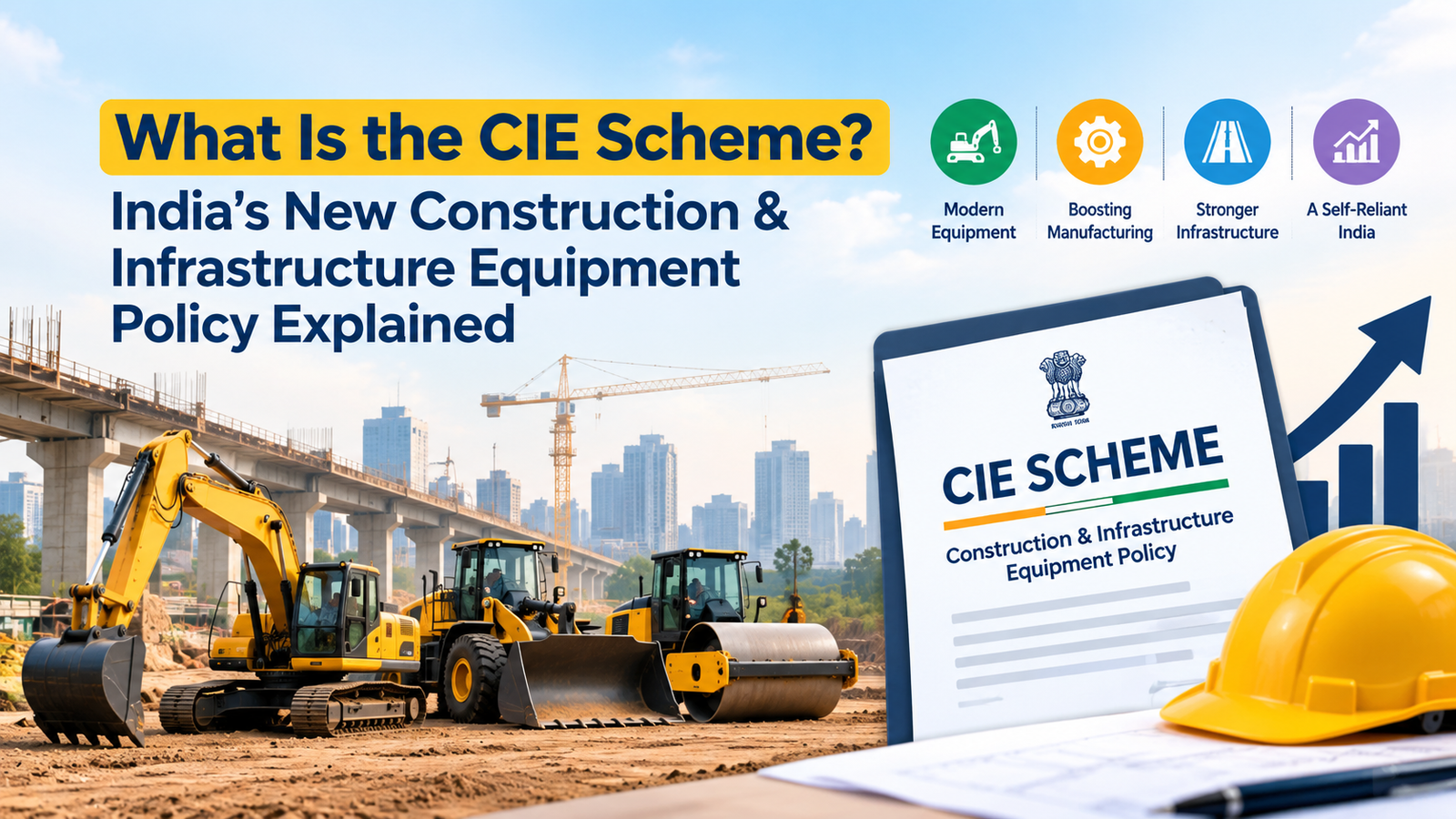

If you follow news about India’s infrastructure and manufacturing sector, you may have come across a new term lately: the CIE Scheme. It sounds technical, but the idea behind it is fairly simple. India builds a lot of roads, metros, and buildings, yet it still imports much of the heavy machinery used to build them. The CIE Scheme is the government’s plan to change that.
In this article, we’ll break down what the CIE Scheme actually means, why it was introduced, how the money will be used, and what it could mean for India’s construction and manufacturing industry over the next several years.
What Is the CIE Scheme?
CIE stands for Construction and Infrastructure Equipment. In full, it is called the Scheme for Enhancement of Construction and Infrastructure Equipment. At its core, it’s a government policy aimed at getting more of India’s heavy construction machinery built inside the country, instead of shipped in from abroad.
Think of the machines that go into building a metro line or a mountain highway: tunnel-boring machines, cranes, elevators for tall buildings, fire-fighting equipment. A large share of this equipment, especially the more advanced kind, is currently imported. The CIE Scheme wants Indian companies to start making these machines here, right from the smaller components to the fully assembled equipment.
The main objectives are straightforward: cut down India’s dependence on imported machinery, build a stronger domestic supply chain for components and subsystems, and encourage both Indian and global manufacturers to set up production in India. The people expected to benefit range widely: equipment manufacturers, component suppliers, construction companies that will get faster access to machinery, and workers who could find new jobs in this growing sector.
Why Was the CIE Scheme Introduced?
India’s infrastructure push has grown massively over the past decade. Highways, metro networks, airports, and housing projects are being built at a pace the country hasn’t seen before, and the government’s capital expenditure budget is over ₹12 lakh crore for the current financial year alone reflects that scale.
But there’s a catch. Much of the heavy and technologically advanced equipment used on these projects is not made in India. Tunnel-boring machines used for metro tunnels and high-altitude roads, for instance, have largely come from overseas suppliers. So has a good part of the components that go into cranes, lifts, and fire-fighting systems. This means Indian infrastructure growth has, in a way, been fuelling manufacturing jobs and expertise in other countries rather than at home.
That’s the gap the CIE Scheme is meant to close. The government wants a domestic equipment industry that can keep pace with the country’s own construction boom, reduce the outflow of money spent on imports, and build the kind of manufacturing base that supports India’s broader self-reliance goals.
Key Highlights of the CIE Scheme
Here’s a quick snapshot of what the scheme involves:
- Announced as part of the Union Budget, with a multi-year outlay expected to be around ₹14,300 crore
- An initial allocation for the first year, with the bulk of the spending planned over the following years
- A strong focus on domestic manufacturing, from raw components to finished machinery
- Coverage across a wide range of equipment lifts, fire-fighting systems, tunnel-boring machines, and other heavy construction machinery
- A target to push domestic value addition, meaning the share of locally made parts in each machine, past the halfway mark
- Expected to unlock much larger private investment than the government’s own outlay
₹14,300 Crore Allocation Under the CIE Scheme
The headline number attached to the CIE Scheme is its ₹14,300 crore allocation, planned to be spent over several years rather than in one go. This isn’t unusual for schemes of this size; the government typically front-loads a smaller amount in the first year and scales up as manufacturers come on board and projects get approved.
So where does this money actually go? A large part is expected to support manufacturers directly through incentives tied to production, help with setting up or upgrading factories, and support for building the supply chain of smaller component makers who feed into bigger equipment assemblers. Some of it is also likely to go toward research and technology development, since a lot of the equipment India currently imports is technologically advanced, and Indian manufacturers will need support to catch up on things like automation, precision engineering, and design capability.
The government has also indicated that this allocation is meant to act as a trigger rather than the full picture. Officials have spoken of the scheme helping to incentivise investment worth far more than the scheme’s own outlay, potentially running into lakhs of crores once private companies respond with their own manufacturing investments.
CIE Scheme’s 7-Year Timeline
The CIE Scheme isn’t designed as a quick, one-year push. It’s structured as a longer, multi-year programme, expected to run over roughly seven years. This timeline matters because building a manufacturing ecosystem from scratch factories, skilled workers, supplier networks, testing facilities takes time. You can’t expect a domestic tunnel-boring machine industry to appear overnight.
In the early phase, expect the focus to be on setting up the scheme’s guidelines, approving manufacturers, and getting the first incentives flowing. The middle years are likely to see actual production ramp up, as factories get built and components start getting sourced locally instead of imported. In the later years, the goal is for the industry to be largely self-sustaining, with Indian manufacturers competing not just for the domestic market but potentially for exports too.
A longer runway also gives industry players the confidence to invest, since manufacturing heavy equipment requires high upfront costs that only pay off over several years.
Focus on Domestic Manufacturing
The heart of the CIE Scheme is domestic manufacturing. The government has set a goal of pushing domestic value addition basically, how much of a machine’s value comes from parts made in India above 50 percent. Right now, for a lot of this equipment, a large chunk of the value comes from imported components, even when final assembly happens in India.
To change this, the scheme is designed to support the entire chain: the small companies making individual parts, the mid-sized firms making subsystems, and the larger players doing final assembly. This wide net matters because you can’t build strong final equipment manufacturing if the components underneath are still all imported.
There’s also a technology angle here. Building competitive machinery isn’t just about assembling parts; it needs precision engineering, quality control, and often automation. The scheme is expected to encourage manufacturers to adopt more advanced production methods, similar to what’s already used in India’s auto industry, where tool-room style manufacturing and just-in-time production have become standard practice.
Expected Investment Under the CIE Scheme
While the government’s own allocation is ₹14,300 crore, officials have talked about the scheme unlocking investment worth around ₹1 lakh crore from the private sector. That’s a big multiplier, and it reflects how these schemes usually work: government money acts as a nudge, and companies bring in the bulk of the actual capital once they see a supportive policy environment.
This investment could come in different forms: new factories built by existing construction equipment makers, expansion by component suppliers who currently serve other industries but want to enter this space, and possibly interest from global equipment manufacturers looking to set up local production in India rather than exporting finished machines here. For India, attracting this kind of manufacturing investment also means more jobs in factories, in supply chains, and in the ancillary services that grow around a manufacturing hub.
How Will the CIE Scheme Benefit India?
If the scheme works as planned, the benefits stretch across several areas. The construction equipment industry itself should grow, both in size and in technical capability. More local manufacturing usually means more jobs, not just in factories but across suppliers, logistics, and services connected to them. It should also reduce India’s import bill for this category of machinery, freeing up money that currently goes overseas.
Over time, there’s also a chance India could start exporting some of this equipment, especially to other developing countries with similar infrastructure needs. And for the construction sector itself, having equipment made locally could mean shorter waiting times and better after-sales support, since manufacturers and service centres would be closer to where the machines are actually used.
Impact on Construction & Infrastructure Companies
For equipment manufacturers already in India, this is an opportunity to expand and move up the value chain, making more advanced machinery instead of just simpler equipment. Component suppliers stand to gain too, since a growing final-assembly industry needs a steady, reliable base of parts makers.
Construction companies themselves the ones actually building metros, highways, and buildings could benefit indirectly through better equipment availability and potentially lower costs over time, as imported machinery gets gradually replaced by domestic alternatives. This could also support wider access to specialized equipment such as small tunnel boring machines for tunnelling and underground infrastructure projects.The scheme could also open the door to new partnerships, with global equipment makers teaming up with Indian firms to combine international technology with local manufacturing.
CIE Scheme and Make in India
The CIE Scheme fits naturally into India’s broader Make in India and Atmanirbhar Bharat push. Both of these campaigns have focused on building domestic manufacturing capacity across sectors, from electronics to defence to pharmaceuticals. Construction equipment has, until now, been a relatively overlooked category compared to some of these other industries, despite India’s construction sector being one of the largest in the world.
By strengthening manufacturing here, the scheme also supports the country’s wider goal of reducing reliance on imports across critical industries, particularly ones tied to infrastructure and national development. And if domestic manufacturers become competitive enough, there’s real potential for India to eventually export construction equipment to other markets, rather than only building for its own needs.
Challenges in Implementing the CIE Scheme
None of this is without hurdles. Building advanced machinery like tunnel-boring equipment requires serious technological know-how, and Indian manufacturers will need time and possibly foreign collaboration to close that gap. There’s also the question of a skilled workforce. Precision manufacturing needs trained engineers and technicians, and India will need to invest in training programmes alongside the manufacturing incentives themselves.
Supply chains are another challenge. Setting up reliable domestic sourcing for hundreds of components isn’t something that happens quickly, and early on, manufacturers may still need to rely on some imported parts even as they scale up local production. There’s also competition to think about established global manufacturers already have decades of experience, strong brand trust, and economies of scale that new Indian entrants will need to compete against. Finally, financing large manufacturing projects requires patient capital, and how easily companies can access affordable funding will shape how fast the scheme’s goals are actually met.
CIE Scheme vs Previous Government Initiatives
India has run manufacturing-focused schemes before, most notably the Production Linked Incentive schemes across sectors like electronics, pharmaceuticals, and automobiles. The CIE Scheme follows a similar logic, using government incentives to pull in private investment, but it’s specifically tailored to construction and infrastructure equipment, a category that hadn’t received this kind of dedicated push before.
What makes it significant is the direct link to India’s own infrastructure spending. Since the government itself is one of the biggest buyers of construction equipment through its highway, railway, and metro projects, there’s a built-in demand base that can support a growing domestic industry, something not every manufacturing scheme has the benefit of.
What Does the CIE Scheme Mean for the Future?
Looking ahead, the scheme’s long-term success will depend on execution just as much as funding. If manufacturers respond well and the supply chain develops as planned, India could see a meaningfully larger construction equipment industry within the scheme’s seven-year window, with higher local content, more jobs, and stronger technical capability.
Globally, the construction equipment market continues to grow alongside urbanisation and infrastructure spending in developing economies. If Indian manufacturers manage to build cost-competitive, quality equipment during this period, India could position itself as a serious player in this market beyond just its own borders. That’s a longer-term possibility, but it’s the direction the scheme is pointed towards.
Conclusion
The CIE Scheme is India’s attempt to fix a long-standing gap: a country building infrastructure at record pace, but still importing much of the machinery that makes it possible. With a planned outlay of around ₹14,300 crore over roughly seven years, the scheme is betting on domestic manufacturers to step up, backed by government incentives and a great, built-in demand from India’s own infrastructure spending.
It won’t happen overnight, and there are real challenges around technology, skills, and competition to work through. But if it plays out as intended, the CIE Scheme could reshape India’s construction equipment industry, creating jobs, cutting import bills, and building a manufacturing base capable of supporting the country’s infrastructure ambitions for years to come.
Frequently Asked Questions About the CIE Scheme
What is the CIE Scheme?
It is a government policy called the Scheme for Enhancement of Construction and Infrastructure Equipment, aimed at boosting domestic manufacturing of construction and infrastructure machinery in India.
What does CIE stand for?
CIE stands for Construction and Infrastructure Equipment.
How much has the government allocated to the CIE Scheme?
The scheme’s overall outlay is expected to be around ₹14,300 crore, spread across multiple years, with a smaller initial allocation in the first year.
What is the duration of the CIE Scheme?
The scheme is designed as a multi-year initiative, expected to run for around seven years.
Why was the CIE Scheme introduced?
It was introduced to reduce India’s dependence on imported construction machinery and build a stronger domestic manufacturing base to support the country’s growing infrastructure sector.
How will the scheme support domestic manufacturing?
By offering incentives across the supply chain from component makers to final equipment assemblers and encouraging higher local content in construction machinery.
What investment is expected under the CIE Scheme?
Beyond the government’s own allocation, the scheme is expected to draw in significantly larger private-sector investment, potentially running into lakhs of crores.
Who can benefit from the CIE Scheme?
Equipment manufacturers, component and subsystem suppliers, construction companies, and workers looking for jobs in this expanding manufacturing sector.