

If you just finished 12th and you are thinking about a career in IT, you have probably come across two names again and again. BCA and BTech. Both are degrees. Both can get you into the IT field. And both show up on almost every list of good options after 12th. So it is normal to feel confused about which one to pick.
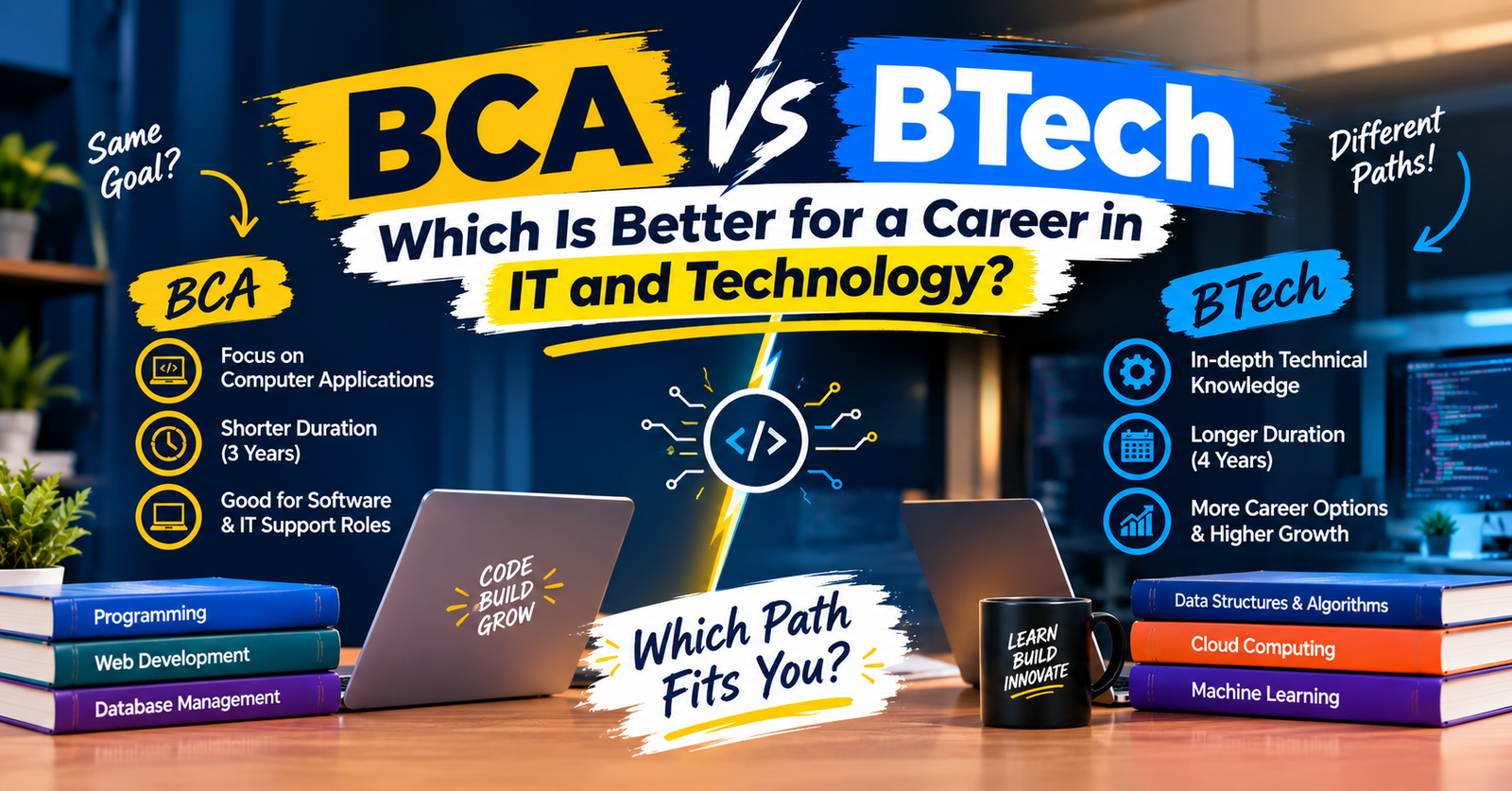
Let us keep this simple. BTech is a longer, more technical engineering degree. It goes deep into computer science along with basic engineering subjects like maths and physics. BCA is a shorter degree that focuses only on computer applications and software. It skips the heavy engineering part and gets straight into programming.
Neither degree is better in every single case. It depends on your background, your budget, and what kind of career you want. In this article, we will explain both degrees in plain language, so that by the end you know exactly which one makes more sense for you.
BCA vs BTech: What is the Difference?
BTech is a 4 year engineering degree. Along with computer science subjects, you also study core engineering topics like physics, maths, and electronics. It is a deeper and more technical degree.
BCA is a 3 year degree. It focuses only on computer applications, programming, and software. There is no engineering part in it. It is shorter, usually cheaper, and gets you ready for the software industry faster.
If your goal is to become a software developer quickly and without spending too much money, BCA can work very well. If you want a stronger technical base, better chances for government or PSU jobs, and an easier path to study further like MTech or MS abroad, BTech is the better fit.
What Is BCA?
BCA stands for Bachelor of Computer Applications. It is a 3 year undergraduate degree that teaches you programming, software development, databases, and how computer applications work.
The subjects are practical and focused on coding. You will learn languages like Java, Python, and C++, along with topics like data structures, web development, and database management. Many students who choose BCA later go on to do an MCA, which is a master’s degree, to make their profile stronger for jobs.
BCA is a good choice if you already know you want to work in software or IT, but you do not want to sit for a tough engineering entrance exam.
What Is BTech CSE?
BTech in Computer Science Engineering is a 4 year engineering degree. It mixes core engineering subjects like maths, physics, and electronics with detailed computer science subjects like algorithms, operating systems, computer networks, and artificial intelligence.
It is a more difficult and research heavy degree compared to BCA. Most students who want to join top tech companies, product based companies, or want to study further in countries like the US, choose BTech.
To get into BTech, most colleges require you to clear JEE Main, and IITs require JEE Advanced. Some private colleges also accept 12th marks directly or have their own entrance test.
BCA vs BTech: Key Differences
| Point | BCA | BTech CSE |
|---|---|---|
| Full form | Bachelor of Computer Applications | Bachelor of Technology in Computer Science |
| Duration | 3 years | 4 years |
| Main focus | Software and programming | Engineering plus deep computer science |
| Entrance exam | Usually not needed | JEE Main or JEE Advanced |
| Fees per year | ₹20,000 to ₹2 lakh | ₹1 lakh to ₹4.5 lakh |
| Degree type | Bachelor’s degree | Engineering degree |
| Further studies | MCA, MBA | MTech, MS, MBA |
| Best for | Faster and cheaper entry into IT | Deeper technical career or higher studies |
BCA vs BTech: Eligibility, Duration and Curriculum
| Point | BCA | BTech CSE |
|---|---|---|
| Who can apply | 12th pass with maths, from any stream in most colleges | 12th pass with Physics, Chemistry, Maths |
| Entrance requirement | Mostly direct admission, a few colleges have their own test | JEE Main or JEE Advanced, or a state or private engineering exam |
| Duration | 3 years, 6 semesters | 4 years, 8 semesters |
| Main subjects | Programming in C, Java, Python, database management, web development, networking | Engineering maths, data structures, algorithms, operating systems, AI and ML, core subjects |
| Practical work | Strong focus on coding projects | A mix of engineering theory and computer science practicals |
| Internships | Present, but not very structured in most colleges | Well organised, especially in top colleges |
BCA vs BTech: Career Scope, Jobs and Salary
Both degrees can get you a good job in IT. The real difference is in the type of role you get, the kind of company that hires you, and how far you can grow.
| Point | BCA | BTech CSE |
|---|---|---|
| Common job roles | Software developer, web developer, system analyst, IT support | Software engineer, data scientist, AI or ML engineer, systems architect |
| Companies that hire | IT service companies, startups, mid sized firms | Product companies, big MNCs, core engineering firms, startups |
| Starting salary | ₹2.5 to ₹6 lakh per year | ₹4 to ₹12 lakh per year, higher from top colleges |
| Growth | Senior developer, team lead, better after doing MCA or MBA | Tech lead, engineering manager, data scientist, research roles |
| Government jobs | Fewer options | Better access, through GATE and PSU exams |
| Studying abroad | Less common | More widely accepted for master’s programs abroad |
BTech usually gives you a wider range of options because of the strong engineering base. It also opens doors to PSU jobs, GATE, and higher studies abroad. BCA gets you working sooner and at a much lower cost, and it can perform just as well in pure software jobs if you build strong coding skills and real projects during the degree.
Best Colleges in India for BTech
Instead of just naming colleges, it is more useful to compare the best colleges in India based on factors such as ranking, degree quality, placements, fees, and admission difficulty. The NIRF 2025 engineering ranking can also be used as one reference point when evaluating top engineering colleges.
| College | NIRF 2025 Rank | Course Quality | Placements | Fees per year | How to get admission |
|---|---|---|---|---|---|
| IIT Madras | 1 | Excellent, strong research | Very strong, top companies visit | ₹2 to ₹2.5 lakh | JEE Advanced |
| IIT Delhi | 2 | Excellent CSE department | Very strong | ₹2 to ₹2.5 lakh | JEE Advanced |
| IIT Bombay | 3 | Excellent, strong industry links | Very strong | ₹2 to ₹2.5 lakh | JEE Advanced |
| NIT Tiruchirappalli | 9, only NIT in top 10 | Strong core and CSE mix | Strong | ₹1.5 to ₹2 lakh | JEE Main |
| BITS Pilani | Around 25 to 29 | Strong, flexible curriculum | Strong, good industry ties | ₹2.5 to ₹4.5 lakh | BITSAT |
| VIT Vellore | Around top 30 to 40 | Good, large CSE batch size | Good, high number of placements | ₹2 to ₹3.5 lakh | VITEEE |
In simple words, IITs are the top choice for ranking, research, and placements, but they are also the hardest to get into. NITs are a good middle option, since the quality is high and fees are lower, but you still need a good JEE Main score. Private colleges like BITS Pilani and VIT may not top the NIRF list, but they still place students well, and getting in is easier through their own entrance exams. This makes them a fair option if you do not clear JEE.
Best Colleges in India for BCA
BCA colleges are not ranked under NIRF’s engineering list, so here the comparison is based on placement record, course quality, fees, and how the admission process works.
| College | Course Quality | Placements | Fees per year | Admission Process |
|---|---|---|---|---|
| Christ University, Bangalore | Strong, well planned syllabus | Good, decent number of recruiters | ₹1 to ₹1.5 lakh | Merit plus entrance test |
| Loyola College, Chennai | Strong academic name | Good, steady placement record | ₹20,000 to ₹40,000 | Merit based |
| Symbiosis Institute of Computer Studies, Pune | Good, modern and updated syllabus | Decent, growing interest from recruiters | ₹1.5 to ₹2 lakh | SET entrance exam |
| NMIMS, Mumbai | Good, updated curriculum | Decent | ₹1.5 to ₹2.5 lakh | NPAT entrance exam |
| St. Xavier’s College, Kolkata | Strong academic base | Moderate | ₹30,000 to ₹60,000 | Merit based |
In simple words, BCA colleges are judged more by city and college reputation than by a national ranking. Christ University and Loyola College are strong choices because they balance good academics, decent placements, and lower fees. Symbiosis and NMIMS cost a bit more but offer a more modern, industry focused syllabus.
BCA vs BTech: Which One Should You Choose?
Here is a simple way to decide, based on your own situation.
Choose BTech if you are comfortable with Physics, Chemistry, and Maths, you are ready to prepare for JEE or a similar exam, and you want a strong technical foundation along with better chances for government jobs or studying abroad later.
Choose BCA if you want to enter the IT field faster and at a lower cost, you are not from a Maths, Physics, Chemistry background, or you simply want to focus on programming without going through core engineering subjects.
Choose BCA followed by MCA if you want the flexibility of a shorter degree now, but still plan to strengthen your profile later with a master’s degree. This combination takes about 5 years in total and can match up well against a BTech degree in the job market.
Both degrees are respected in the IT industry today. Companies increasingly care more about your actual skills, your projects, and your internships than which of the two degrees you hold.
Conclusion
Both BCA and BTech can lead to a good career in IT. The right choice depends on your background, your budget, and how you want to enter the field.
If you come from a Maths, Physics, Chemistry background, can prepare for JEE, and want a broader engineering foundation with strong placements and future study options, BTech CSE is the stronger long term choice. If you want a quicker, more affordable, and more focused path straight into software jobs, BCA is a smart and increasingly respected option, especially when you follow it up with an MCA.
Whichever degree you pick, remember that the degree only gets your foot in the door. In the IT industry, the projects you build, the internships you complete, and the skills you keep learning matter just as much as the degree itself.