
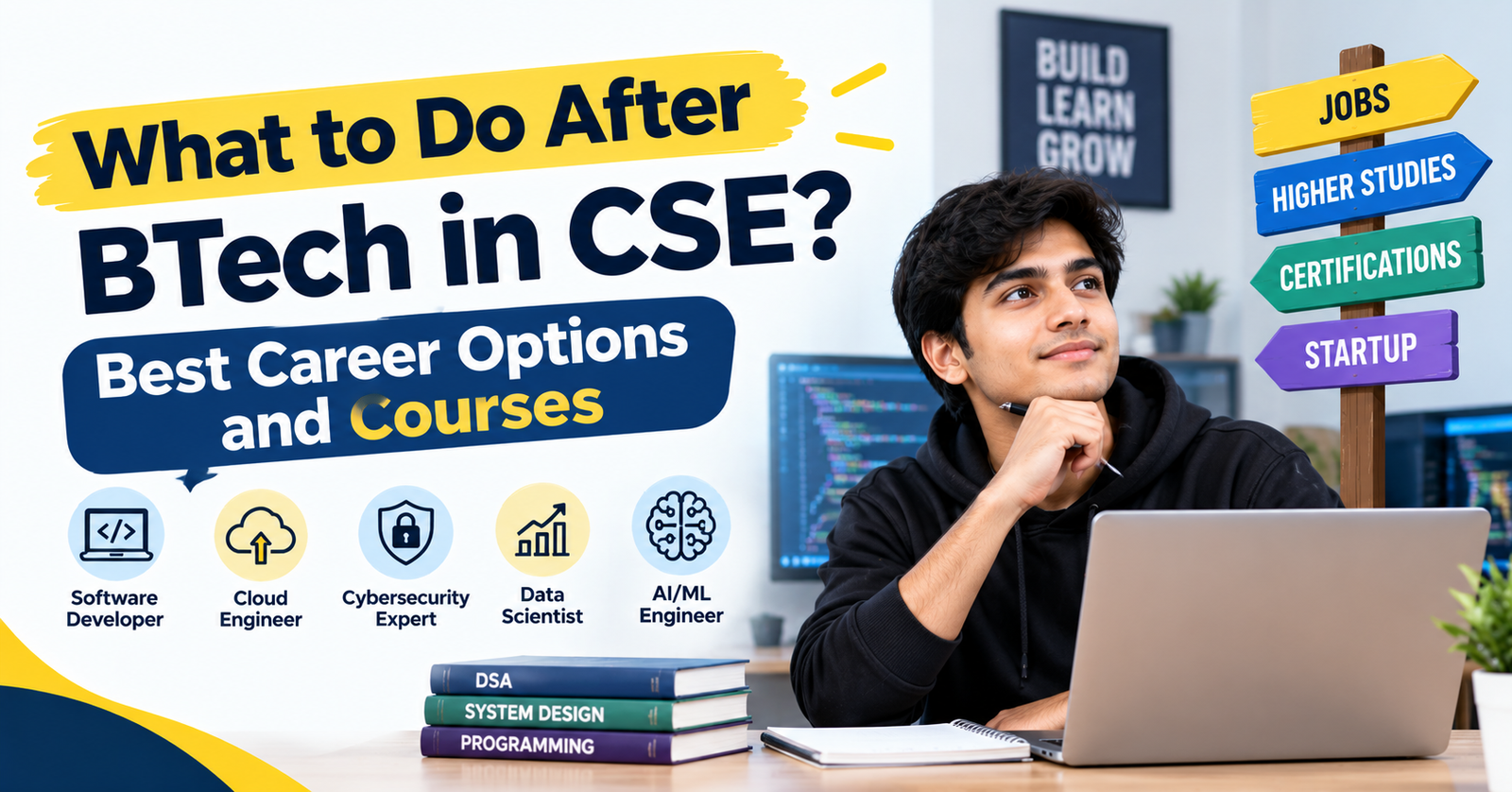

Finishing BTech CSE is a big moment. Four years of assignments, projects, and exams are behind you, and now everyone around you is asking the same question: “So, job or higher studies?”
There is a great answer waiting for you here, and it depends on what you enjoy, how soon you want to start earning, and where you eventually want to end up. Some CSE graduates go straight into a job. Others do MTech, MBA, or MS first. Both paths work well, if you pick the one that actually fits you.
This guide walks you through every real option after BTech CSE, what each one actually leads to, and how to decide without the confusion.
What to Do After BTech in CSE?
In simple words, you have four doors open right now:
- Get a job start earning and learning on the ground, right away
- Study further MTech, MBA, or MS, depending on where you want to go
- Learn a specific skill and go solo freelancing, building your own product, or joining a startup
- Prepare for government exams GATE-based PSU jobs, banking, or similar, if stability matters most to you
Most people don’t pick just one of these forever. A common path is: work for a year or two, save some money, figure out what you enjoy, then decide on higher studies with much more clarity.
What Are the Best Career Options After BTech CSE?
Here’s a quick look at where CSE graduates usually end up:
| Career Option | Best Suited For | Typical Timeline |
|---|---|---|
| Software Developer / Engineer | Students who enjoy coding and want to start working soon | Immediate |
| Data Scientist / AI-ML Engineer | Students good with math and problem-solving | Immediate, with some upskilling |
| MTech (CSE/AI/Data Science) | Students who want research, teaching, or a stronger technical base | 2 years |
| MBA | Students who want to move into management or business roles | 2 years |
| MS (Abroad) | Students aiming for global tech companies or research | 1.5–2 years |
| Govt Jobs / PSU (via GATE) | Students who want a stable, secure career | 6 months–1 year prep |
| Freelancing / Startup | Students confident in one skill and okay with some risk | No fixed timeline |
Let’s break each of these down properly.
Get a Job After BTech CSE
For most CSE graduates, this is the simplest and often smartest first move even if you plan to study more later.
Why a job first makes sense:
- You start earning right away instead of spending more on education
- You learn things no classroom teaches you real deadlines, real bugs, real teamwork
- Work experience makes a later MBA or MS application much stronger
- You get time to figure out what you actually enjoy before locking into a specialisation
Common roles for freshers:
- Software Development Engineer (SDE)
- Data Analyst or Junior Data Scientist
- QA / Test Engineer
- DevOps Engineer
- Cybersecurity Analyst
Where people usually get hired: campus placements, big product companies (Google, Amazon, Microsoft, Flipkart), service companies (TCS, Infosys, Wipro, Accenture), and startups. Product companies tend to pay more. Service companies are usually easier to get into and give you broader early exposure.
Pursue Higher Studies After BTech CSE
If you want to go deeper technically, switch into management, or aim for opportunities abroad, higher studies is the way to go. There are three main routes here: MTech, MBA, and MS and each one is built for a different goal.
Do MTech After BTech CSE
MTech makes sense if you want to specialise further in AI, Data Science, VLSI, or Networks or if you’re aiming for research work or a teaching career.
How people get in: Mostly through GATE (Graduate Aptitude Test in Engineering). A good GATE score can also get you into PSU jobs like ISRO, BHEL, or ONGC as a solid backup even if MTech doesn’t work out.
This is a good fit if:
- You genuinely enjoyed academics during BTech
- You’re thinking about a PhD later, or a career in research
- You want to try for PSU jobs through GATE
One honest note: MTech by itself doesn’t automatically mean a higher salary than someone with 2 years of work experience. It really pays off when it’s combined with actual research work or a clear specialisation goal.
Do MBA After BTech CSE
An MBA makes sense once you’ve realised you enjoy the business side more things like strategy, client handling, or leading a team more than writing code all day.
When to do it: Most people do well with an MBA after 2–4 years of work experience, not right after BTech. That experience makes your application stronger and helps you get more out of the degree.
This is a good fit if:
- You want to move into Product Management
- You’re interested in consulting or leadership roles
- You eventually want to start and run your own company
Common entrance exams: CAT, XAT, or GMAT for global business schools.
Do MS After BTech CSE
MS (Master of Science) usually suits students who want advanced technical roles at global companies, or who are open to settling abroad long-term in places like the US, Canada, Germany, or Australia.
This is a good fit if:
- You genuinely enjoy a specific technical area AI, Robotics, Cybersecurity, Cloud Computing
- You’re considering research or a PhD later
- You’re okay living and working outside India
What you’ll usually need: GRE (many universities now make this optional), good academic scores, letters of recommendation, a statement of purpose, and ideally some project or internship experience in your chosen area.
Be honest about the cost: MS abroad is often ₹25–60 lakh depending on the country and university. It can absolutely pay off through better roles later, but it’s worth planning the money side carefully first for loans, scholarships, or assistantships.
Learn In-Demand Skills After BTech CSE
No matter which path you pick, your BTech syllabus alone won’t be enough. Here’s what companies are actually hiring for right now:
- AI and Machine Learning : Python, TensorFlow or PyTorch, and real applied projects
- Cloud Computing : AWS, Azure, or Google Cloud certifications
- Data Science and Analytics : SQL, Python, Power BI or Tableau
- DevOps :Docker, Kubernetes, CI/CD pipelines
- Cybersecurity : ethical hacking, basic network security
- Full-Stack Development : a modern frontend framework (like React) plus a backend (Node.js, Django, or Spring Boot)
Don’t try to learn all of these at once. Pick one or two that match the direction you’re leaning toward, and go deep. A strong project in one area beats a shallow certificate in five.
How to Get a 10 Lakh Salary After BTech CSE?
A 10 LPA package is possible, but it rarely happens by luck. It usually comes from a mix of these things:
- Build a strong profile, even if your college isn’t top-tier : a solid GitHub or portfolio can make up for a lot
- Pick a high-paying skill area : AI/ML, Data Science, and Cloud roles usually pay more than general development
- Aim for product-based companies :they typically pay noticeably more than service companies for similar roles
- Build real projects, not tutorial copies : interviewers can tell the difference quickly
- Practice DSA and system design seriously : this is what most product-company interviews actually test
Most fresher salaries in India fall between ₹3.5–8 LPA. Graduates with strong skills, real projects, or a good college behind them often cross into the ₹10–20 LPA range. If salary is the main thing driving your decision right now, our guide on the highest paying jobs in India breaks down exactly which roles and skills get you there fastest.
Job vs MTech vs MBA vs MS: Which Is Better After BTech CSE?
There is no single winner here, only what fits your situation best.
| Factor | Job | MTech | MBA | MS |
|---|---|---|---|---|
| Time to start earning | Immediate | 2 years | 2 years | 1.5–2 years |
| Cost | None (you earn) | Low (government colleges via GATE) | Moderate to high | High, especially abroad |
| Best for | Quick start, real-world learning | Research, technical depth, PSU jobs | Management, leadership roles | Global tech roles, research |
| Work experience needed first? | Not needed | Not needed | Helpful (2–4 years) | Helpful, not mandatory |
| Risk level | Low | Low to moderate | Moderate | Moderate to high (financially) |
| Long-term payoff | Steady growth with experience | Strong for research or teaching | Strong for management track | Strong for a global career |
How to Choose What to Do After BTech in CSE?
Ask yourself these questions, in order the answers usually make the decision much clearer:
- Do I need to start earning right now? If yes, take the job. You can always study further later.
- Am I more drawn to research and technical depth, or to leadership and business? Research points to MTech or MS. Leadership points to MBA.
- Can I actually afford higher studies right now? If not, work for a year or two, save up, and revisit this decision with a clearer head.
- Do I see myself working in India or abroad long-term? This alone often decides between MTech/MBA and MS.
- What did I genuinely enjoy during BTech? The coding, the math, talking to people, or leading a team? This matters more than any salary number.
There is no need to have it all figured out immediately. Plenty of successful engineers took a job first and did an MBA or MS years later. Plenty went straight into MTech and built strong research careers. The important part is choosing on purpose, not just following what your friends are doing.
If college choice is still influencing how you think about your career direction, it’s worth reading our breakdown of private BTech colleges in India too, since the right college can open up options you haven’t considered yet.
Conclusion
There is a great path waiting for you after BTech CSE. It just depends on what you enjoy, how soon you want to start earning, and where you eventually want to end up. A job gets you earning and learning fast. MTech takes you deeper technically. MBA opens the door to management. MS opens the door to a global career.
Take your time, but don’t overthink it either. Pick the option that fits where you are right now, commit to it fully, and keep learning no matter which door you walk through. That’s what actually shapes your career, more than the choice itself ever will.
Frequently Asked Questions
Is MTech necessary after BTech CSE?
No. It’s useful for research, teaching, or PSU jobs through GATE. Going straight into a job is just as valid a choice.
Should I do an MBA right after BTech or work first?
Working for 2–4 years first is usually the better move. It strengthens your application and helps you actually use the degree well.
Is MS abroad worth it after BTech CSE?
It can be, especially for global tech roles or research careers as long as you plan the finances carefully through savings, scholarships, or assistantships.
What’s the fastest way to a well-paying job after BTech CSE?
Software Development, Data Science, and Cloud roles at product-based companies currently offer the quickest path to a strong starting salary.
Can I switch careers after BTech CSE if I don’t enjoy coding?
Yes, easily. Many CSE graduates move into product management, business roles, or even non-tech fields through an MBA or the right upskilling. The degree is a strong base, not a fixed path.