
Search “best online learning platform” and you get a hundred lists that all say the same thing. The real problem is different: most learners pick a platform by brand name, finish a few videos, and end up with a certificate but no job-ready skills.
This guide compares five widely used platforms on what actually matters: depth, credibility, projects, certification value, career support, and cost. It also shows how AI is changing online learning and what certificates can and cannot do for your career.
Why Choosing the Right EdTech Platform Matters for Career Growth
The right platform saves you months and money by matching how you learn with what employers actually look for. The wrong one can cost the same money and give you nothing but a PDF.
Learning vs. Career-Oriented Education
| Type | Goal | Typical Platform Style |
|---|---|---|
| Learning-oriented | Understand a topic or build basics. | Free or low-cost, self-paced courses |
| Career-oriented | Get job-ready for a specific role. | Structured programs with projects, mentors, and career support |
What Learners Should Evaluate Before Enrolling
- Is the curriculum current, or is it years old?
- Will you build real projects, or only watch videos?
- Who teaches it, and who stands behind the certificate?
- What is the full cost, including renewals and add-ons?
- What happens if you get stuck: is there doubt support?
What to Look for in an EdTech Platform in 2027
Skip the usual “benefits of eLearning.” Use these eight decision factors instead:
| Factor | What to Check | Red Flag |
|---|---|---|
| Course depth and curriculum | Syllabus, level, last update date | Vague topics, no outline |
| Instructor and institution credibility | University, company, or verified expert behind it | No instructor details |
| Hands-on projects | Labs, capstones, real datasets | Only quizzes and videos |
| Certification value | Who issues it and who recognizes it | Certificate promised as a job guarantee |
| Career support | Resume help, mock interviews, hiring network | Vague “100% placement” claims |
| Learning flexibility | Self-paced, live, or hybrid | Fixed schedule that does not fit your life |
| Cost and value for money | Total price, refund policy, free trial | Hidden fees, no refund terms |
| AI-powered learning features | AI tutor, personalized paths, feedback | AI used only as a marketing label |
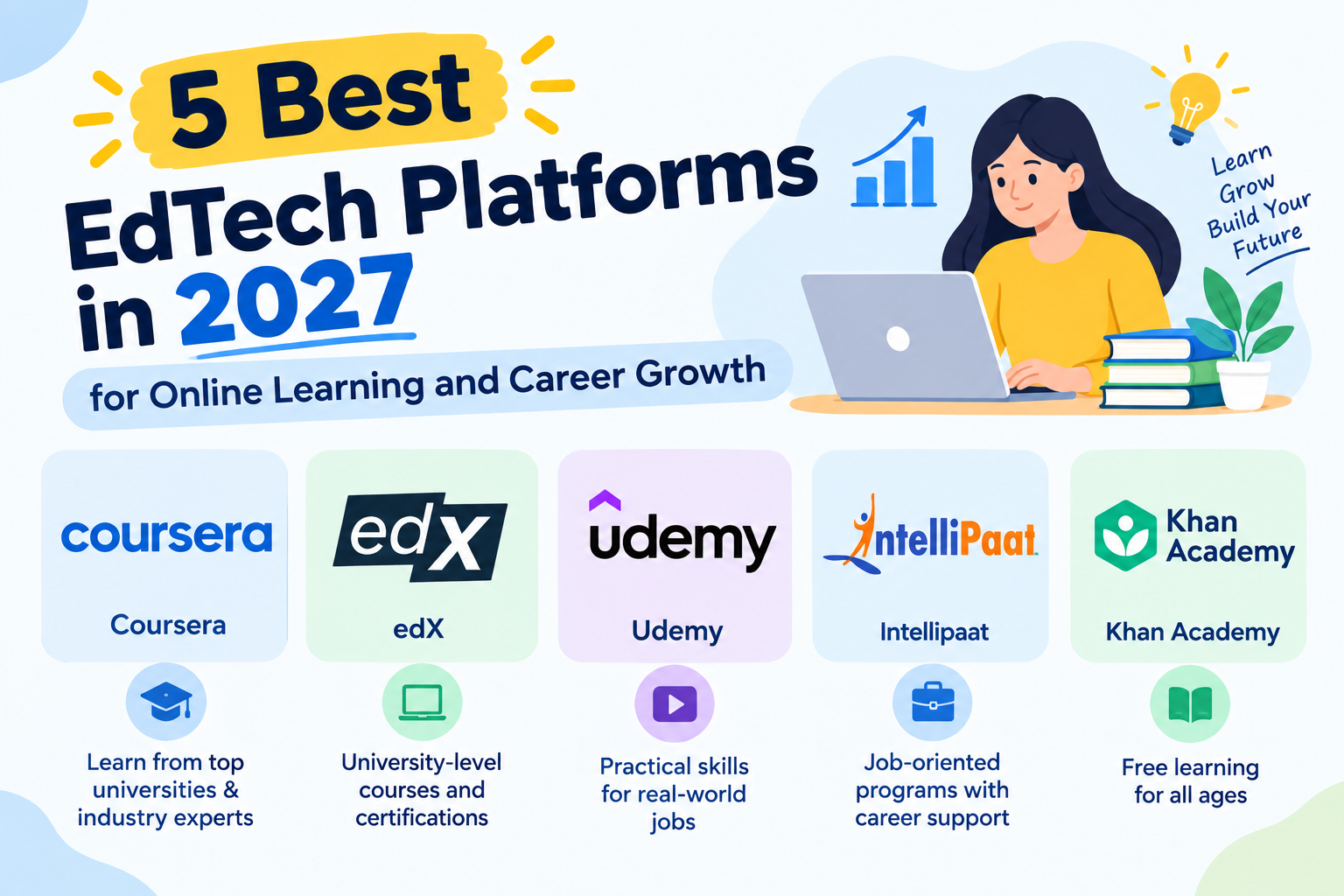
5 Best EdTech Platforms in 2027
1. Coursera: Best for University-Backed Learning
Coursera works with universities and companies to offer courses, specializations, professional certificates, and online degrees. Its company reported partnerships with over 375 universities and industry partners and 191 million registered users as of September 2025.
| Point | Details |
|---|---|
| Best suited for | Learners who want a recognized brand behind their certificate or a path to a degree |
| Learning model | Structured video lessons, quizzes, assignments, and projects; courses grouped into specializations and professional certificates |
| Partnerships | University and industry partners, including major tech and education names |
| Degrees | Online bachelor’s and master’s programs from partner universities |
| Career relevance | Strong for entry-level tech, data, business, and AI skills; role-based skill tracks |
| AI features | AI learning tools such as Coach and Role Play, as described by the company |
Pros: credible partners, clear learning paths, wide subject range.
Limitations: certificates and degrees can cost more than marketplace courses, some content is more theory-heavy, and quality varies by partner. Free access options differ by course, so check each course page.
Industry update: Coursera completed its merger with Udemy on May 11, 2026. Udemy has said both brands continue to operate independently for now, so check the latest before you buy.
2. edX: Best for Academic and Professional Education
edX began as a Harvard and MIT initiative and is now operated by 2U. 2U reports more than 250 university and enterprise partnerships and over 5,300 programs on edX (June 2026).
| Point | Details |
|---|---|
| Best suited for | Learners who want academic depth and university-led content |
| Learning model | University-style courses with deadlines or self-paced options, depending on the program |
| Credentials | Professional certificates, microcredentials, executive education, and online degree options through partner universities |
| Academic depth | Strong in computer science, data, engineering, business, and sciences |
| AI features | AI learning assistant and an edX app inside ChatGPT, announced by 2U in 2026 |
Pros: serious academic content, respected university names, good for structured study.
Limitations: paid certificates and degrees can be expensive, the format can feel formal, and the company has changed hands, so check current offers and certificate rules.
3. Udemy: Best for Skill-Based and Self-Paced Learning
Udemy is a marketplace where independent instructors publish courses on thousands of practical topics, from Python to Photoshop to digital marketing.
| Point | Details |
|---|---|
| Best suited for | Learning one specific, practical skill quickly |
| Course variety | Very wide: tech, design, business, marketing, personal development |
| Learning model | Self-paced video lessons taught by individual instructors |
| Pricing approach | Per-course purchase with frequent discounts, plus subscription options; purchased courses stay available for lifetime access, subject to Udemy’s terms |
| Practical learning | Many project-based courses, but depth depends on the instructor |
Pros: affordable, flexible, huge choice.
Limitations: quality varies widely, certificates of completion are not university credentials, and there is little career support. Always check ratings, recent reviews, and the “last updated” date before buying.
4. Intellipaat: Best for Career-Focused Technology Programs
Intellipaat is an India-based online training provider focused on technology programs such as data science, AI, cloud, DevOps, and cybersecurity. It lists collaborations with institutions such as IIT Madras and IIT Roorkee and companies such as Microsoft for selected programs.
| Point | Details |
|---|---|
| Best suited for | Career switchers and professionals who want live classes, mentors, and structured tech training |
| Learning model | Live online classes, recorded sessions, assignments, and doubt support, depending on the program |
| Industry projects | Hands-on projects and capstones in most career programs |
| Certification | Program certificates; some are issued with academic partners. |
| Career support | Resume help, mock interviews, and placement assistance, with eligibility conditions |
Pros: guided, mentor-led format, practical projects, career preparation.
Limitations: it costs more than self-paced marketplaces, live sessions need a fixed time commitment, and public reviews are mixed, so verify claims before paying.
Smart check: “Placement assistance” is not a job guarantee. Before enrolling in any career program, ask for the full syllabus, fee and refund terms, and placement eligibility conditions, and speak to a few past learners.
5. Khan Academy: Best for Building Strong Academic Foundations
Khan Academy is a nonprofit that offers free lessons and practice across subjects such as math, science, computing, economics, and test prep.
| Point | Details |
|---|---|
| Best suited for | School students, college beginners, and adults rebuilding fundamentals |
| Subjects | Mathematics, science, computing, humanities, economics, test prep |
| Learning model | Short lessons, mastery-based practice, and instant feedback |
| Cost | Core learning is free; its Khanmigo AI tutor is a paid add-on for learners, while teachers can access it free in supported regions |
| Certificates | No accredited certificates |
Pros: free, high-quality teaching, great for fundamentals.
Limitations: not designed for job-specific career skills, and it does not offer credentials employers look for.
Which EdTech Platform Is Best for Your Career Goal?
| Career or Learning Goal | Recommended Platform | Why |
|---|---|---|
| University-backed certifications | Coursera | Partner universities and professional certificates |
| Academic learning and deeper theory | edX | University-led programs and academic depth |
| Learning one specific practical skill | Udemy | Affordable, focused, self-paced courses |
| Technology career programs | Intellipaat | Live classes, projects, mentors, career support |
| Academic fundamentals | Khan Academy | Free and strong on basics |
Coursera vs edX vs Udemy vs Intellipaat vs Khan Academy
| Criteria | Coursera | edX | Udemy | Intellipaat | Khan Academy |
|---|---|---|---|---|---|
| Learning format | Structured, self-paced | University-style | Self-paced video | Live plus recorded | Short lessons and practice |
| Course variety | Very high | High | Very high | Focused on tech | Core academics |
| Career focus | High | Medium to high | Skill-based | Very high | Low |
| Practical projects | Yes, it varies. | Yes, it varies. | Varies by instructor | Yes, industry projects | Practice exercises |
| Certification | University and industry certificates | University-linked credentials | Completion certificate | Program certificate | None |
| Academic credibility | High | High | Low to medium | Medium, varies by partner | High for fundamentals |
| Flexibility | High | Medium to high | Very high | Medium (live schedule) | Very high |
| Beginner-friendly | Yes | Yes | Yes | Yes | Very |
| Best use case | Recognized credentials | Academic depth | Quick skills | Career switch in tech | Strong basics |
Which Platform Is Best for Students vs Working Professionals?
| Learner Type | Best Pick | Why | Tip |
|---|---|---|---|
| College students | Coursera or Khan Academy | Credible certificates plus free fundamentals | Add a project to your resume |
| Fresh graduates | Coursera or Intellipaat | Structured path with career preparation | Build a portfolio alongside |
| Career switchers | Intellipaat or Coursera | Guided learning and career support | Ask about outcomes and refund terms |
| Working professionals | edX, Coursera, or Udemy | Flexible, self-paced study | Pick short, role-relevant courses |
| Learners wanting technical skills | Udemy or Intellipaat | Practical, hands-on content | Choose recent, project-based courses |
How AI Is Changing Online Learning in 2027
| AI Change | What It Does | Example |
|---|---|---|
| AI tutors | Answer questions and guide you step by step | Khanmigo on Khan Academy |
| Personalized learning paths | Suggests what to study next | Role-based skill tracks on Coursera |
| AI-assisted assessments | Gives instant feedback on practice and writing | Learning assistants on edX and other platforms |
| Adaptive learning | Adjusts difficulty to your level | Mastery-based practice |
| AI career recommendations | Matches skills to roles | Skills and role tools on major platforms |
| Skill-gap analysis | Shows what you still need to learn | Used in team and enterprise learning |
A word of caution: AI tutors can make mistakes. Use them to practice and get unstuck, but verify important facts with your course material or a human mentor.
Final Verdict: Which EdTech Platform Should You Choose in 2027?
| If You Want… | Choose |
|---|---|
| A recognized certificate or online degree | Coursera |
| Academic depth from universities | edX |
| A practical skill at low cost | Udemy |
| A guided tech career switch with live classes | Intellipaat |
| Free, strong fundamentals | Khan Academy |
A smart combination also works: build basics on Khan Academy, learn a skill on Udemy, then add a recognized certificate from Coursera or edX, or join a live program like Intellipaat if you need guided career support.
Conclusion
The best EdTech platform is the one that matches your goal, budget, and learning style and gives you proof of skill, not just a certificate. Start with a clear goal, shortlist two platforms, check the syllabus and terms, and begin with a small project in week one.
Want to practice what you learn? Turn your course notes into a practice quiz with our free PDF to Quiz Converter
Frequently Asked Questions (FAQs)
For career growth, choose a platform with projects, recognized certification, and career support. Coursera and Intellipaat are common choices, depending on whether you want a university brand or live mentoring.
Coursera is better for university-backed certificates and structured paths. Udemy is better for quick, affordable, practical skills. Both are now part of the same company after the 2026 merger, but they still operate as separate platforms for now.
Yes, edX offers professional certificates, microcredentials, and university-led programs. Check current pricing and credential rules before you enroll.
They help most when backed by projects and real skills. A certificate alone rarely gets a job, but a certificate plus a portfolio can strengthen your application.
It offers live, mentor-led programs in data science, AI, cloud, and other tech fields. It can suit career switchers, but reviews are mixed, so check the syllabus, fees, refund terms, and placement conditions first.