

Most beginners start a blog the same way. They write a few posts, share them on social media, and wait. Three months later, traffic is still close to zero and motivation is gone.
The problem is rarely effort. It is the missing plan. In this guide on sitekibaat, you will learn what a content strategy is and how to build one step by step, in simple language.
What Is a Content Strategy?
A content strategy is a plan that explains what content you will create, who it is for, where you will publish it, and what goal it should achieve.
Think of it like a road map. Without a map you can drive for hours and still not reach your destination. Without a strategy you can post every day and still not get traffic, leads, or sales.
A good content strategy answers five simple questions:
| Question | What You Decide |
|---|---|
| Who? | Your target audience |
| What? | Topics and content formats |
| Where? | Website, YouTube, Instagram, email, etc. |
| When? | Your publishing schedule |
| Why? | Your goal (traffic, leads, sales, brand) |
Why Does Content Strategy Matter?
A strategy turns random posting into a system. Here is what you get from it:
- You save time. You always know what to write next.
- You get more traffic. You target topics people really search for.
- You build trust. Regular, helpful content makes readers come back.
- You waste less money. Every piece has a clear purpose.
- Your SEO improves. A group of connected articles ranks better than scattered posts.
Content Strategy vs Content Marketing: What Is the Difference?
People often mix these two up. The easy way to remember: strategy is the plan, marketing is the action.
| Point | Content Strategy | Content Marketing |
|---|---|---|
| Meaning | The plan | Doing the plan |
| Focus | Why and what | How and where |
| Example | “We will help beginners with simple how-to guides” | “We publish 3 blogs and 5 reels every week” |
| Done | Once, then reviewed every few months | Every day or week |
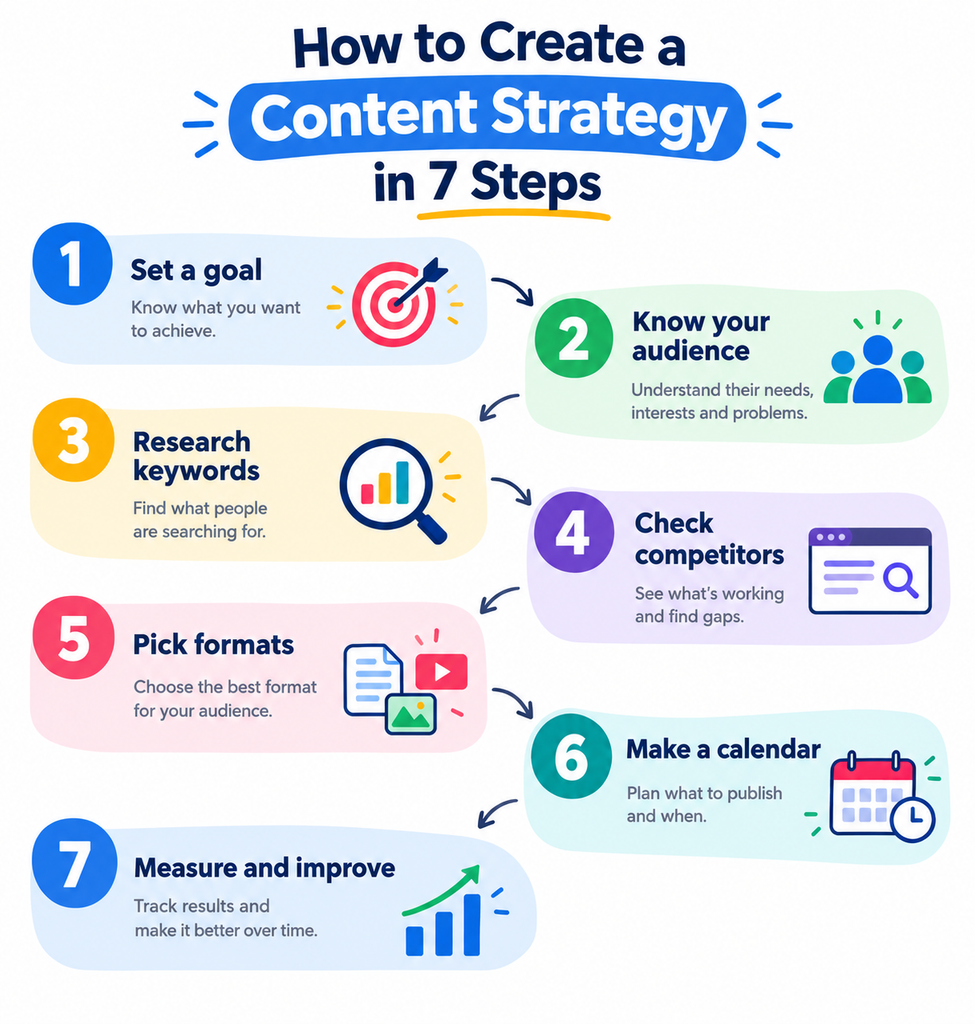
How to Create a Content Strategy in 7 Steps
Step 1: Set a Clear Goal
Be specific. I want more traffic, which is weak. I want 10,000 monthly visitors in 6 months is strong. Common goals are traffic, leads, sales, brand awareness, and email subscribers. Pick one main goal to start.
Step 2: Know Your Audience
Write down who you are creating for, including their age, job, problems, and questions. For example, Rahul, 21, is a BCA student who is confused about which course or career to choose. When you write for one clear person, your content feels personal and helpful.
Step 3: Do Keyword and Topic Research
Find out what your audience types into Google. Free options are Google Autocomplete, the “People Also Ask” box, and Google Keyword Planner. For every article, choose:
- One primary keyword (the main topic)
- Two to four secondary keywords (related phrases)
- Question keywords like “what,” “why,” and “how,” which help you appear in AI answers
Step 4: Check Your Competitors
Search your main keyword and read the top five results. Ask what they explain well, what they missed, and how you can be simpler and more useful. The gaps you find are your best chance to rank. This is called a content gap analysis.
Step 5: Choose Content Types and Channels
Match your formats to your audience: blog posts, short videos, YouTube, infographics, newsletters, or social posts. Beginner tip: do not try everything. Start with blog articles plus one social platform.
Step 6: Build a Content Calendar
A content calendar is a simple Google Sheet. Use these columns: Topic, Keyword, Format, Publish Date, and Status. Be realistic. Two good articles every week beat seven planned articles that you abandon after ten days.
Step 7: Publish, Measure, and Improve
Check your numbers once a month and update weak articles. Refreshing an old post often works faster than writing a new one.
| What to Track | Where to Check | Why It Matters |
|---|---|---|
| Traffic | Google Analytics | Shows how many people visit |
| Keyword rankings | Google Search Console | Shows if you are moving up |
| Time on page | Google Analytics | Shows if people actually read |
| Sign-ups or clicks | Analytics events | Shows if content reaches your goal |
Content Strategy Example
Imagine a website like Sitekibaat that helps students choose tech careers. A simple strategy could look like this:
| Part | Plan |
|---|---|
| Goal | 20,000 monthly visitors in 6 months |
| Audience | Students after 12th who are confused about courses |
| Main topics | Course comparisons, career guides, free study tools |
| Formats | Blog articles, FAQs, short videos |
| Schedule | 4 articles every week |
| Measure | Traffic, keyword rankings, tool clicks |
Each article links to related ones. A “BCA vs BTech” post links to career guides and study tools. This is internal linking, and it helps both readers and Google understand your site.
Free Tools to Plan Your Content
| Tool | What You Use It For |
|---|---|
| Google Search Console | See which searches bring you traffic |
| Google Trends | Spot rising topics early |
| Google Analytics | Understand visitor behaviour |
| AnswerThePublic | Find real questions people ask |
| Google Sheets or Notion | Build your content calendar |
| Canva | Make simple graphics |
You do not need paid tools to begin. Free tools are enough for your first six months.
Common Content Strategy Mistakes to Avoid
- No clear goal. You cannot measure success without one.
- Writing only for search engines. Write for people first.
- Ignoring search intent. If someone wants a quick answer, do not give them a 5,000-word essay.
- Publishing without a plan. Random posts rarely rank.
- Never updating old content. Outdated pages slowly lose rankings.
- Skipping promotion. Great content still needs to be shared.
- Copying competitors. Add your own examples and simpler explanations.
How to Make Your Content Strategy Work for AI Search (GEO and AEO)
People now get answers from Google AI Overviews, ChatGPT, Perplexity, and voice assistants, not only from blue links. Two ideas help you show up there.
| Term | Full Form | What It Means |
|---|---|---|
| AEO | Answer Engine Optimization | Writing short, direct answers that can appear as featured snippets and voice answers |
| GEO | Generative Engine Optimization | Writing clear, trustworthy content that AI tools can understand, quote, and cite |
Simple ways to apply both:
- Start each section with a one or two-line direct answer, like the definition at the top of this guide.
- Use question-style headings such as “What is…?” and “How to…?”
- Add an FAQ section to every article.
- Use tables, lists, and steps. AI tools find structured content easy to read.
- Show real expertise with examples, dates, and facts.
- Keep your brand name and author details clear so AI tools can name you as the source.
Conclusion
A content strategy turns random posting into a clear system. Start small: pick one goal, know one audience, choose your keywords, and publish on a schedule. Track what works, fix what does not, and write so that both people and AI tools can understand you easily.
Frequently Asked Questions (FAQs)
A content strategy is a plan for creating and sharing content to reach a goal such as traffic, leads, or sales. It decides what to publish, for whom, and where.
The main parts are goals, audience research, keyword research, content types, a content calendar, and performance tracking.
Set one clear goal, understand your audience, research keywords, check competitors, choose your formats, build a calendar, and review results every month.
Most websites see early results in 3 to 6 months. SEO is slower than ads, but the results last longer.
eview it every three months and adjust based on traffic, rankings, and audience feedback.

This is a brilliant breakdown of how to build a solid content strategy in just 7 steps! I especially like the emphasis on structuring content to truly resonate with the target audience. In fact, when we were designing our latest online course, applying a structured framework like the one you outlined here made a massive difference in keeping learners engaged and mapping out the syllabus effectively. Thanks for sharing such actionable insights. Do you find that keyword mapping is usually the best starting point once the audience persona is defined?
Absolutely! I’d say keyword mapping is one of the best starting points once the audience persona is clearly defined. It helps connect the audience’s search intent with the right content topics and ensures that each piece of content has a clear purpose. From there, you can build topic clusters and map keywords across the customer journey.