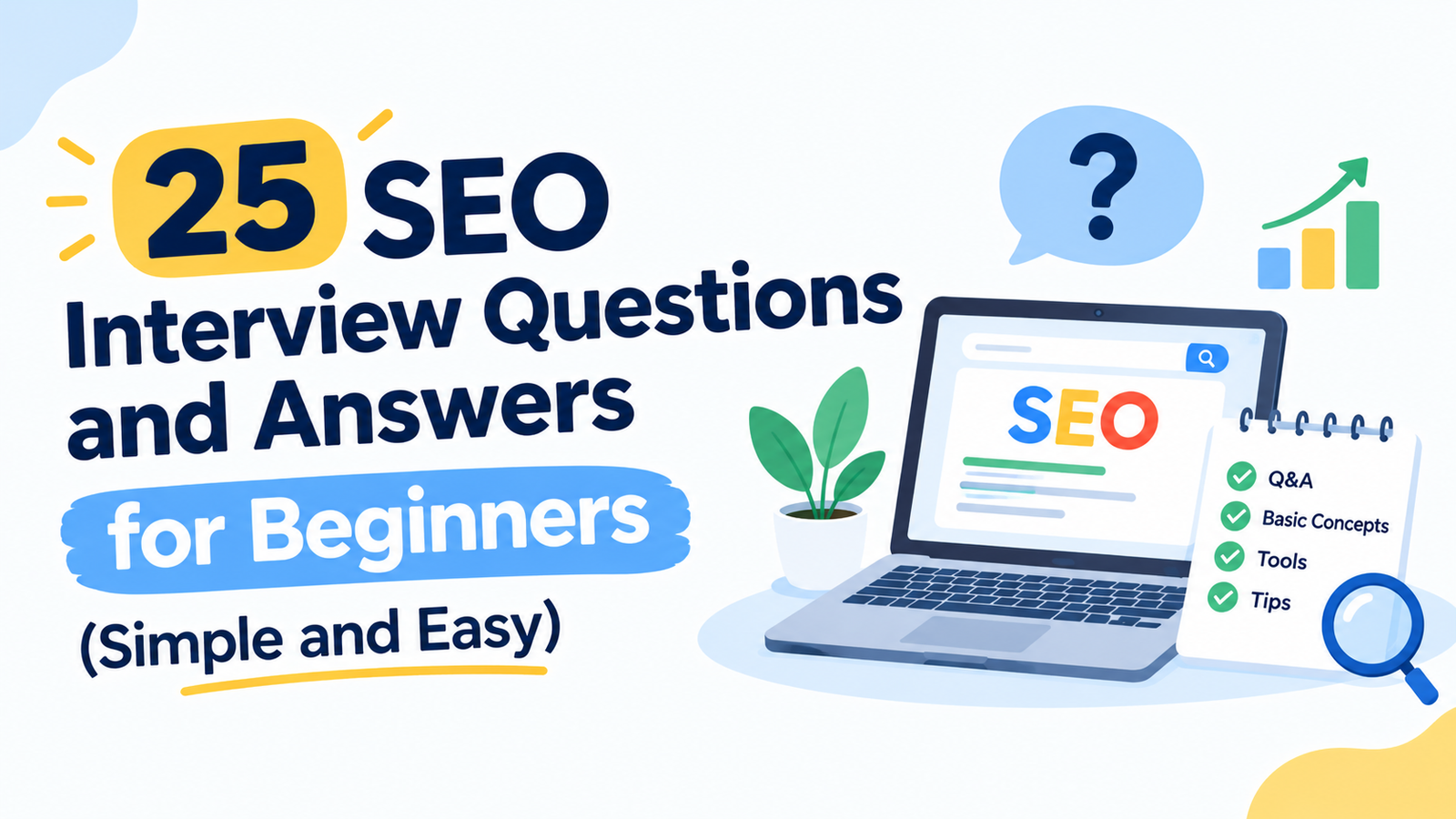

Your first SEO interview can feel scary, but the questions are usually simple. Interviewers want to see if you understand the basics and can explain them clearly.
This guide from Sitekibaat gives you 25 beginner-level SEO interview questions with short, easy answers. Read them, say them out loud in your own words, and you will be ready.
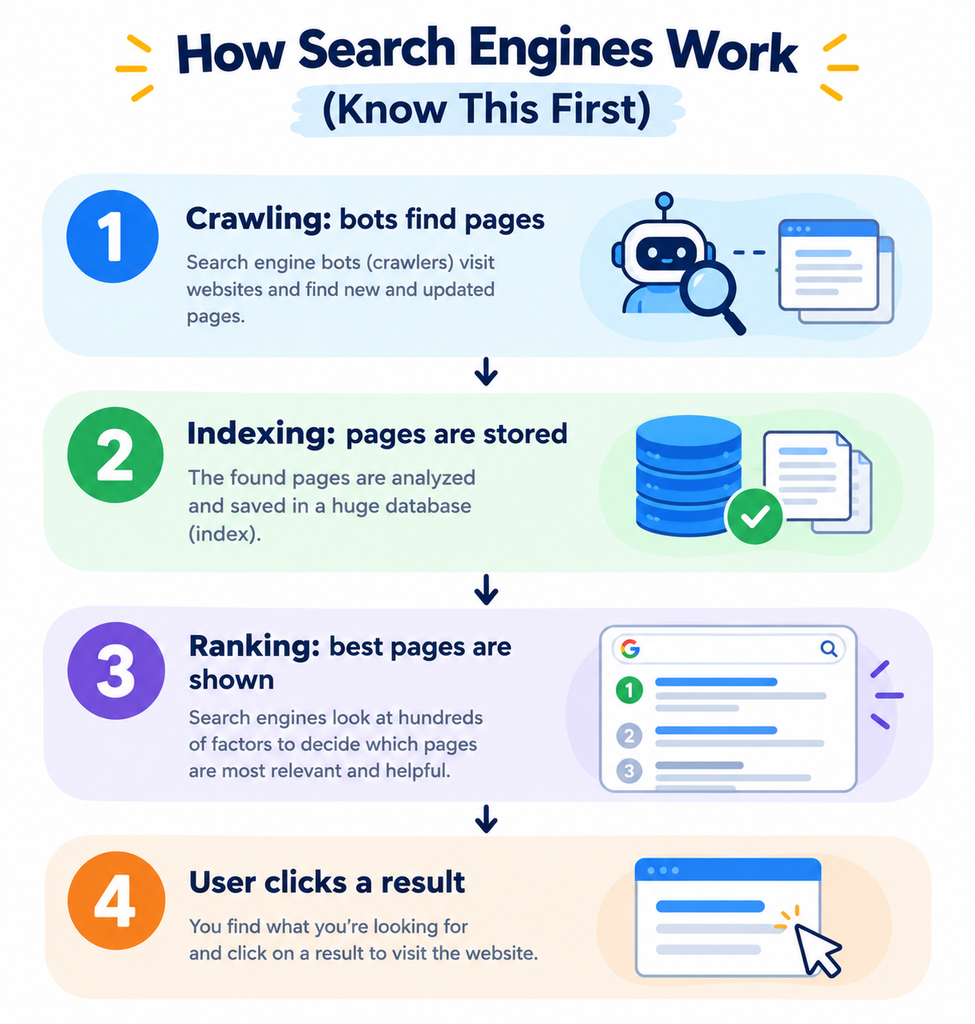
How Search Engines Work (Know This First)
Almost every interview starts here. A search engine finds pages (crawling), stores them (indexing), and then shows the best ones for a search (ranking).
Basic SEO Interview Questions
1. What is SEO?
SEO means search engine optimization. It is the process of improving your website so it appears higher in search results like Google, without paying for ads.
2. Why is SEO important?
Most people click on the first few search results. SEO brings free, long-lasting traffic, builds trust, and helps a business get found by people who are already looking for it.
3. What are the types of SEO?
There are three main types: on-page SEO, off-page SEO, and technical SEO. Some people also add local SEO and content SEO.
4. What is a keyword?
A keyword is a word or phrase people type into a search engine, like “best laptop under 50000”. We use keywords in content so search engines understand what our page is about.
5. What is search intent?
Search intent is the reason behind a search. It can be informational (learn something), navigational (find a site), commercial (compare options), or transactional (buy something). Good content matches the intent.
6. What is the difference between SEO and SEM?
SEO gets free (organic) traffic. SEM includes paid ads like Google Ads. So SEO is one part of search marketing, and paid search is the other.
7. What is the difference between organic and paid results?
Organic results appear because the page deserves to rank. Paid results are ads where the business pays for each click. Paid results are marked “Sponsored.”
8. What is the difference between white hat and black hat SEO?
White hat SEO follows search engine rules, like writing helpful content. Black hat SEO uses tricks like keyword stuffing and buying links and can get your site penalized.
| Type of SEO | What It Covers | Simple Example |
|---|---|---|
| On-page | Things on your page | Titles, headings, content, images |
| Off-page | Things outside your site | Backlinks, brand mentions |
| Technical | Site health and speed | Sitemap, page speed, mobile-friendly |
On-Page SEO Interview Questions
9. What is on-page SEO?
On-page SEO means optimising everything on your own page: content, title, meta description, headings, URL, images, and internal links.
10. What is a meta title and a meta description?
The meta title is the clickable headline in search results (keep it under 60 characters). The meta description is the short summary below it (about 150 to 160 characters). Both help people decide to click.
11. What is a URL slug?
A slug is the last part of a URL, such as /bca-vs-btech. A good slug is short, readable, and contains the main keyword.
12. What are heading tags (H1 to H6)?
Heading tags structure your content. H1 is the main title and should be used once per page. H2 and H3 are subheadings that organize the sections.
13. What is internal linking?
Internal linking means linking from one page of your website to another. It helps visitors find more content and helps Google understand which pages are important.
14. What is alt text?
Alt text is a short description added to an image. It helps visually impaired users, and it helps search engines understand the image.
Off-Page SEO Interview Questions
15. What is off-page SEO?
Off-page SEO covers actions outside your website that build trust and authority, mainly backlinks, brand mentions, and social sharing.
16. What is a backlink?
A backlink is a link from another website to yours. Backlinks work like votes of trust. Links from respected, relevant sites are worth much more than many low-quality ones.
17. What is the difference between dofollow and nofollow links?
A dofollow link passes ranking value to the linked site. A nofollow link tells search engines not to pass that value. A natural link profile has both.
Technical SEO Interview Questions
18. What is technical SEO?
Technical SEO makes sure search engines can easily crawl, understand, and index your site. It includes site speed, mobile-friendliness, sitemaps, and fixing errors.
19. What are a sitemap and robots.txt?
A sitemap is a file that lists your important pages for search engines. Robots.txt is a file that tells crawlers which parts of your site they can or cannot visit.
20. What is mobile-first indexing?
Google mainly uses the mobile version of your website to index and rank it. So your site must load fast and look good on phones.
Tools, Trends, and Practical Questions
21. Which SEO tools do you know?
For beginners, the key free tools are Google Search Console (see your search performance), Google Analytics (track visitors), and Google Keyword Planner (find keywords). Paid tools include Ahrefs, Semrush, and Moz.
22. What is E-E-A-T?
E-E-A-T means Experience, Expertise, Authoritativeness, and Trustworthiness. It is how Google judges content quality. Show real experience, name the author, and share accurate information.
23. What are AEO and GEO?
AEO (Answer Engine Optimization) means writing short, direct answers for featured snippets and voice search. GEO (Generative Engine Optimization) means creating clear, trusted content that AI tools like ChatGPT and Google AI Overviews can quote.
24. What is a Google algorithm update?
It is a change in how Google ranks pages. Big updates can move rankings up or down. The safe approach is to focus on helpful content instead of chasing tricks.
25. How would you do SEO for a new website?
First do keyword research, then plan content. Next, optimize titles, headings, and URLs. Make the site fast and mobile-friendly, submit a sitemap in Search Console, publish regularly, build quality backlinks, and track results every month.
Quick Revision Cheat Sheet
Read this table the night before your interview:
| Topic | Remember This |
|---|---|
| Meta title | Under 60 characters, with the main keyword |
| Meta description | About 150 to 160 characters, written to get clicks |
| H1 | Only one per page |
| Slug | Short, readable, with the keyword |
| Backlink | A vote of trust from another site |
| Sitemap | List of pages for search engines |
| E-E-A-T | Experience, Expertise, Authoritativeness, Trust |
| AEO and GEO | Optimising for answer engines and AI tools |
5 Tips to Crack Your First SEO Interview
- Use simple words. Clear answers beat fancy ones.
- Give examples. Say, “For a BCA vs. BTech article, my keyword would be…” It shows real thinking.
- Build a small project. Start a blog and show your Search Console screenshots.
- Stay updated. Read about AI search, AEO, and GEO because interviewers love current topics.
- Be honest. If you do not know something, say you will learn it. That is better than guessing.
Conclusion
SEO interviews for beginners test your basics, not your advanced skills. If you can explain crawling, keywords, on-page SEO, backlinks, technical SEO, and AI search clearly, you are already ahead of many candidates. Practise these 25 answers in your own words, and good luck with your interview!